
a word from our sponsors

reviews
 |
 |
 |
 |
 |
 |
 |
|
smart, sophisticated Seattle Rep Dream topped—and toppled—by amazing Bottom |
|
By Prospero
|
|
Seattle, Washington 2/12/2001 | For most of the evening, artistic director Sharon Ott's production of A Midsummer Night's Dream at the Seattle Repertory Theatre sustains the most welcome kind of suspense a veteran Shakespeare playgoer can have the pleasure of feeling: How long can she and her company keep the rather unconventional and interesting balls they've tossed into the air off the ground—and how big will the payoff be in the end? And by the end of the evening, you'd have to admit that the company had juggled very well, yielding a payoff in no way inconsiderable—except that by then it no longer seemed to matter quite so much, after a surprising bit of nonsense had entirely broken the mold of the production. Instead, you left the theater puzzled as to how an unexceptional piece of stage business, recapitulated for a good 15 slapstick minutes by the clownish actor who played Bottom, had managed to drive you and nearly everyone else in the theater into irresistible fits of hysterical laughter for as long as he persisted—yet also quite contented, for the most part, that it had. But I'm getting a little preposterous myself, disclosing my end
before I've really even begun the review. Let me back up again,
and give you a clearer account of what went down, and how precisely
it unfolded. Shakespeare in SeattleMy companion and I had been looking forward to catching this Dream ever since we discovered that Ott, known for her intriguing work at the helm of the Berkeley Rep, had preceded us in abandoning the now completely overcrowded, overpriced, and overanxious San Francisco Bay area for Seattle's more hospitable climes, where she has pledged to put on at least one Shakespeare play a season. And on this, our first visit to her new theatrical home, we were hardly disappointed by the atmosphere we found. On entering the Bagley Wright Theatre, we were surprised at how large, homey and welcoming the space and the gathering crowd that inhabited it seemed, having the air more of a large cocktail party than a tony opening-night event. Two, maybe three well-spaced bars dispensed libations; a Torrefazione coffee stand offered espresso in their midst. Ample space and surfaces for noshing were provided by a large octagonal chamber in the shadow of the Space Needle—including the upholstered banquette fronting a picture window to which we retired, sipping latte. I was somewhat mystified, however, by a long line forming along
one of the approaches to the orchestra door, which we bypassed when
it came time to present the usher our tickets. The mystery was solved
a few minutes before the curtain rose, when a score or two of rush
ticket holders were escorted to the best as yet unoccupied seats.
I applaud the democracy of the system—why should the well-heeled
have the right to monopolize seats they have no intention of using?
This is a community theater, after all—something rare in my
experience of late. artful by designThe production presented in this space was no staid Masterpiece Theater (or RSC/BBC) imitation, but rather a challenging piece of theater that delighted most in going against convention—not willy nilly, but with well-pondered wit and verve. Ott and crew order all things by contraries here, unrolling an ever-expanding list of strong and unusual interpretive choices that keep the audience wondering—how will all these new ways of imagining the Dream work themselves out? In retrospect, this approach was apparent from the very first moment, when Puck appeared onstage to silently open the Chinese box of a set, disclosing an interior scene dominated by long lines of mirrors and an obviously synthetic moon. How intriguing to make such a point of enclosing a play typically presented in the open air at summer festivals within a variety of artful devices, not one of which had the air of naturalness we've come to expect with this play—for if this was the first such surprise that set designer Hugh Landwehr has in store for us, it was not certainly not the last. And what a Puck! At first sight, you could hardly believe it must be him: arch, sophisticated, self-deprecatingly debonair, Dan Donohue's slyly Riddler-esque sprite was a revelation, in comparison with the enfant terribles we've come to expect. With a halt in his gait and slight stammer in his speech, as the night unfolded Donohue's mature roué of a Puck would avail himself of the many opportunities his impediments provided to wring new meaning from lines and actions typically presented at too rapid a clip, in too unknowing a fashion. Professors are fond of pointing out the veiled tension in the opening lines Theseus and Hipployta exchange. Few would go so far as to suggest, however, that his anxiety should reach the sticking point to which Brent Harris screwed it here, or her hostility the openness attained in Suzanne Bouchard's portrayal. Craven and cringing in his pursuit of Hippolyta's affection, you wondered how Harris's Theseus had managed to win enough of her love that marriage was even a possibility—especially when Bouchard's Hippolyta appeared so willful in withholding it. From first to last, just what might be up between these two became the fundamental question underpinning Ott's production.
Part 2: signs of weakness? |
| Copyright © 2001 Dana Spradley, Publisher, for
shakespeare.com. Production photo © 2001
Chris Bennion. Used by permission. First posted Sunday February 18, 2001. |
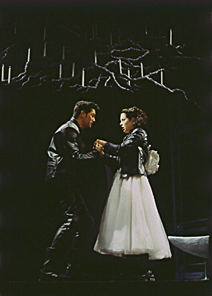 After
this tense induction—which Egeus's eruption could do little
to heighten—the entrance of Kirsten Potter's army-booted Hermia
and her biker boyfriend Lysander (Matthew Troyer) was like a breath
of fresh air: comedy at last! Neither was taking any guff from anyone—not
the corporate Egeus (Laurence Ballard), nor his yuppie son Demetrius
(Jeffries Thaiss), not even from our anxious friend Theseus.
After
this tense induction—which Egeus's eruption could do little
to heighten—the entrance of Kirsten Potter's army-booted Hermia
and her biker boyfriend Lysander (Matthew Troyer) was like a breath
of fresh air: comedy at last! Neither was taking any guff from anyone—not
the corporate Egeus (Laurence Ballard), nor his yuppie son Demetrius
(Jeffries Thaiss), not even from our anxious friend Theseus.A Midsummer Night's Dream plays through March 17.
For more information on this and other plays in the Seattle Repertory Theatre season, see their website.